

tl;dr: Ontario teachers are paid according to a structured salary grid with two dimensions – your qualifications category (A through A4) and your years of experience. For the 2025-2026 school year, starting salaries begin around $51,370 and max out at roughly $119,969 for the most qualified, most experienced teachers. A binding arbitration ruling in 2024 secured an 11.73% compounded raise for ETFO members over the 2022-2026 agreement – the largest increase in over a decade. Principals and long-serving teachers are appearing on the Sunshine List in growing numbers.
If you’ve ever tried to look up what Ontario teachers make, you’ve probably run into a wall of conflicting numbers. One source says the average is $73,500. Another says $32,000. And somewhere in the middle, someone’s telling you teachers max out at $120,000. They’re all technically referencing real data – they’re just describing very different things.
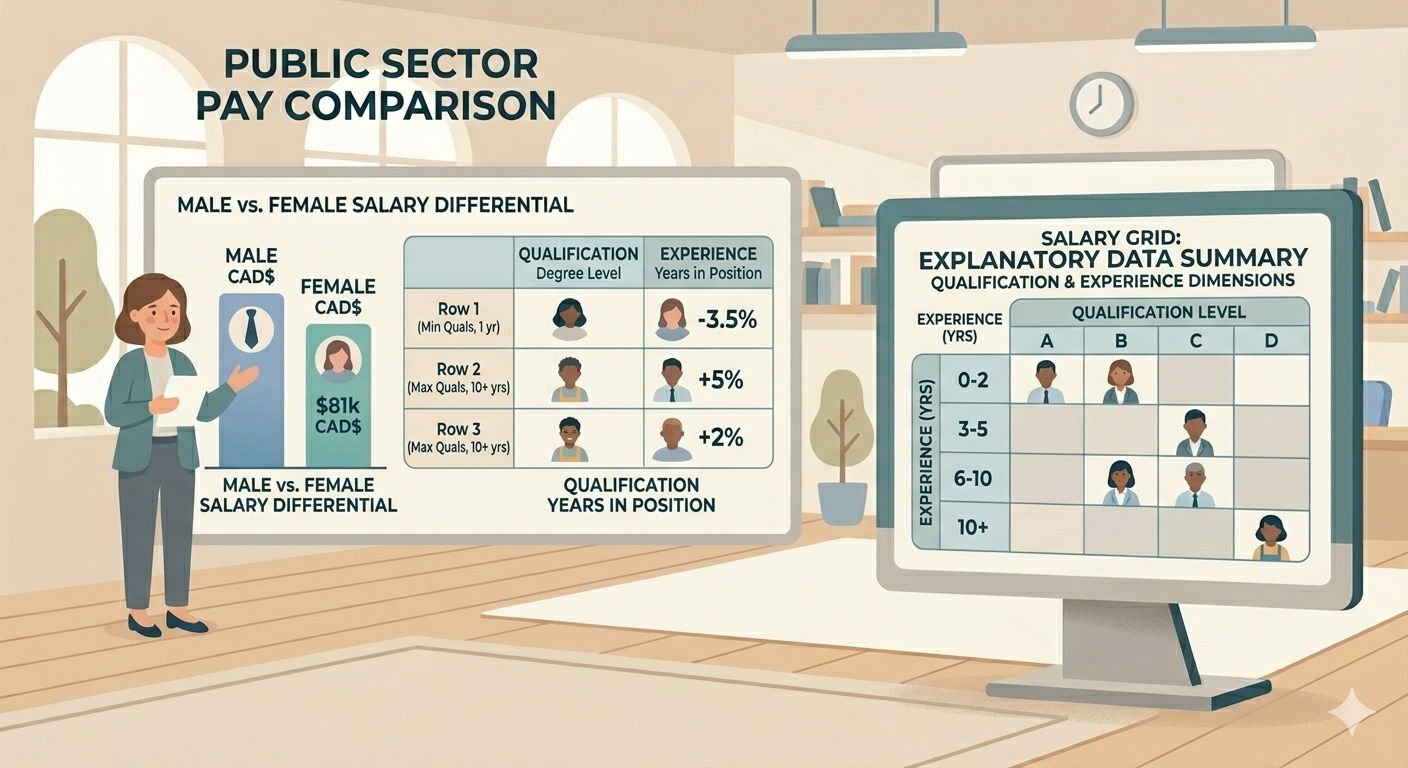
The reason Ontario teacher salary figures vary so much is that teachers don’t earn a single flat wage. They’re paid according to a structured salary grid that accounts for two things: how many years of teaching experience you have, and what your qualifications look like. Understanding that grid is the key to making sense of any number you see.
This guide walks through how the Ontario teacher salary grid actually works in 2025-2026, what the recent arbitration award means for current pay, and where the Sunshine List fits into the picture.
How the Ontario Teacher Salary Grid Works
Most publicly funded school boards in Ontario use a salary grid that’s negotiated through collective agreements between teacher federations, school boards, and the provincial government. The current agreements cover the 2022-2026 period.
The grid has two dimensions.
The first is your qualifications category. The Qualifications Evaluation Council of Ontario – known as QECO – evaluates your academic credentials and assigns you a category ranging from A through A4. A teacher with a three-year undergraduate degree and a Bachelor of Education would typically start at Category A or A1. A teacher with a master’s degree and additional specialist certifications may qualify for Category A3 or A4. The higher your category, the higher your base salary at every step of the grid.
The second dimension is your experience step. Each full year of recognized teaching experience generally moves you one step up the grid. Most boards run from Step 0 up to Step 10 or 11, depending on the specific collective agreement. Steps accumulate automatically – you don’t negotiate them.
What this means in practice is that two teachers starting in the same school on the same day can earn meaningfully different salaries if one arrives with more qualifications or prior teaching experience that the board recognizes.
What the 2025-2026 Salary Grid Actually Shows
One of the more useful publicly available grids comes from the Halton District School Board’s ETFO local, which published its salary schedule for September 1, 2025 to August 31, 2026. It gives a clear picture of the range across categories and steps.
At the bottom of the grid – Category A, Step 0 – starting salary sits at $51,370. That’s where a teacher with no recognized prior experience and the minimum qualifications would begin.
Move across to Category A4 (the highest qualifications tier) and that same starting step rises to $70,194. Already, before accumulating a single year of experience, the gap between the lowest and highest categories at entry level is nearly $19,000 per year.
By the time you factor in experience, the top of the grid – Category A4, Step 11 – reaches $119,969.
The middle of the range, roughly where most working teachers with several years of experience sit, falls somewhere between $75,000 and $100,000 depending on category and step.
For reference, Canada’s Job Bank shows secondary school teachers in Ontario typically earning between $29.33 and $61.54 per hour, which works out to a range of roughly $57,000 to $120,000 annually on a full-time basis. That tracks closely with what the grid shows.
The Recent Arbitration Award and What It Changed
Here’s the part that’s worth knowing if you’re comparing today’s teacher salaries to figures from a few years ago.
In May 2024, a binding arbitration board awarded ETFO’s 80,000 teacher and occasional teacher members salary increases of 11.25% over the term of the 2022-2026 collective agreement. When compounded, that works out to an 11.73% increase over four years. The breakdown was 3% for 2022-23, 3% for 2023-24, 2.75% for 2024-25, and 2.5% for 2025-26.
ETFO described this as the highest increase over the term of an agreement in over a decade. OSSTF members – secondary school teachers in the public system – received the same percentage increases under a parallel ruling.
The increase applies across the board: salary grids, wage schedules, allowances, and the daily occasional teacher rate. So when you look at the current grid numbers and compare them to pre-2022 figures, the jump is real – and it’s mostly attributable to this arbitration outcome, not to any individual raise or negotiation.
For context, the provincial government’s original offer at the bargaining table had been 1.25% per year. The arbitration award came in significantly higher than that – which is exactly why ETFO had pushed to have compensation settled through arbitration rather than direct bargaining.
What Occasional Teachers Earn
Supply teaching – or occasional teaching – sits outside the regular grid in important ways.
Daily occasional teachers in Ontario are paid a flat per diem rate rather than a grid salary. That rate varies by board. At the Toronto District School Board for the 2025-2026 school year, the daily rate for elementary occasional teachers ranges from $289.52 for those with fewer than 100 lifetime days taught at the board, to $299.05 for those with 100 or more days.
The ETFO arbitration award also addressed occasional teacher compensation specifically. It established a new baseline average rate for daily OT pay as of September 1, 2024, with boards paying below that baseline required to increase to it. Over the full agreement, ETFO expects the compounded increase for daily OTs moving to the new baseline to land in the range of 14% to 15%.
Long-term occasional teachers – those filling positions for an extended assignment – are typically paid according to the regular salary grid, calculated on a per-diem basis of 1/194 of their annual grid rate for each day worked.
Teachers on the Ontario Sunshine List
One way to track how teacher compensation has shifted over time is through the Ontario Sunshine List, the province’s annual disclosure of public sector employees earning $100,000 or more.
The 2025 Sunshine List – covering calendar year 2024 earnings, released in March 2026 – reported over 400,000 public sector employees earning above $100,000 for the first time ever. School boards contributed significantly to that growth.
According to reporting on the 2025 list, nearly half of the year-over-year growth was driven by the school board sector, with teachers accounting for 87% of that increase. The provincial government attributed this to across-the-board salary adjustments, retroactive payments from the 2024 and 2025 calendar years, and collective bargaining outcomes.
That framing matters. Teachers showing up on the Sunshine List in growing numbers doesn’t mean base salaries have suddenly surged past $100,000 for most working teachers. It reflects a combination of retroactive payments from the arbitration award, grid progression for experienced staff, and the fact that the $100,000 threshold hasn’t changed since 1996 – while inflation has significantly eroded what that number actually means.
In a school board like the Upper Canada District School Board, the 2025 list included 1,437 employees, of whom 1,209 were teachers. Principals and vice-principals made up a significant portion of the non-teaching entries. Directors of Education at large boards typically earn well above $200,000 annually.
You can explore the full Sunshine List yourself at the Ontario government’s public salary disclosure database. For context on how those trends fit into the broader public sector picture, the analysis at PublicPayPulse public sector insights is worth browsing.
Principals, Vice-Principals, and Beyond the Classroom
Teaching is only one part of the education sector salary picture. Moving into administration changes things considerably.
Principals and vice-principals in Ontario are not covered by the same collective agreements as classroom teachers. They’re typically employed under separate arrangements, and their compensation reflects both the added responsibility and the fact that they’ve generally maxed out the teacher grid before making the move.
Reporting from local Sunshine Lists across the province shows principals at mid-sized boards frequently earning between $130,000 and $180,000. Directors of Education at large urban boards regularly appear above $250,000. These figures include all taxable earnings, which in some years may include retroactive adjustments.
Benefits and the Ontario Teachers’ Pension Plan
Salary is only part of what makes teaching in Ontario’s publicly funded school boards a competitive career choice.
Ontario teachers who work in publicly funded schools are members of the Ontario Teachers’ Pension Plan (OTPP), widely regarded as one of the strongest defined benefit pension plans in the country. It provides a predictable retirement income based on years of service and salary – something increasingly rare in the broader labour market.
Teachers also receive health and dental benefits through the ETFO Employee Life and Health Trust or its equivalent for other federations, paid sick leave provisions, and access to professional development funds.
For anyone weighing public sector teaching against private sector alternatives, the full compensation picture – not just the grid salary – is the right thing to compare.
If you’re interested in how teacher compensation compares to other large public sector workforces in Ontario, you can find detailed breakdowns on nurses, correctional officers, social workers, and municipal workers at PublicPayPulse public sector insights.
So What Does an Ontario Teacher Actually Make?
Here’s the honest summary.
A brand-new teacher entering at the lowest qualifications category and no prior experience starts around $51,370 for the 2025-2026 school year. A new teacher entering with stronger qualifications – a master’s degree and an A4 category placement – could start at $70,194 even before accumulating experience steps.
A teacher with 8 to 10 years of experience and Category A2 or A3 qualifications likely earns somewhere in the $90,000 to $105,000 range. At the top of the grid – maximum experience, Category A4 – the figure is just under $120,000.
The 2022-2026 collective agreement, with its arbitrated 11.73% compounded wage increase, has pushed those numbers meaningfully higher than they were four years ago. The next round of bargaining will begin when the current agreements expire in 2026, so this is a number worth watching as that process unfolds.
In the meantime, if you want to dig into the Ontario government’s own public salary data, the Sunshine List is updated annually at ontario.ca.