

tl;dr: The Ontario Public Service remote work policy changed drastically in 2025 and 2026. After years of hybrid arrangements, the Ford government ordered all 60,000+ OPS employees back to the office full time as of January 5, 2026. Some flexibility still exists through formal Alternative Work Arrangement (AWA) requests and disability accommodations — but the days of casual hybrid work in the OPS are, for now, over.
If you’re an Ontario government employee, or you’re thinking about joining the OPS, the question of remote and hybrid work is probably front of mind. And honestly? The answer right now is more complicated than a simple yes or no.
The Ontario Public Service remote work policy has gone through a lot in a short period of time. What looked like a settled hybrid model just a couple of years ago was swept away pretty abruptly in 2025. This article breaks down exactly what happened, where things stand today, and what options employees might still have.

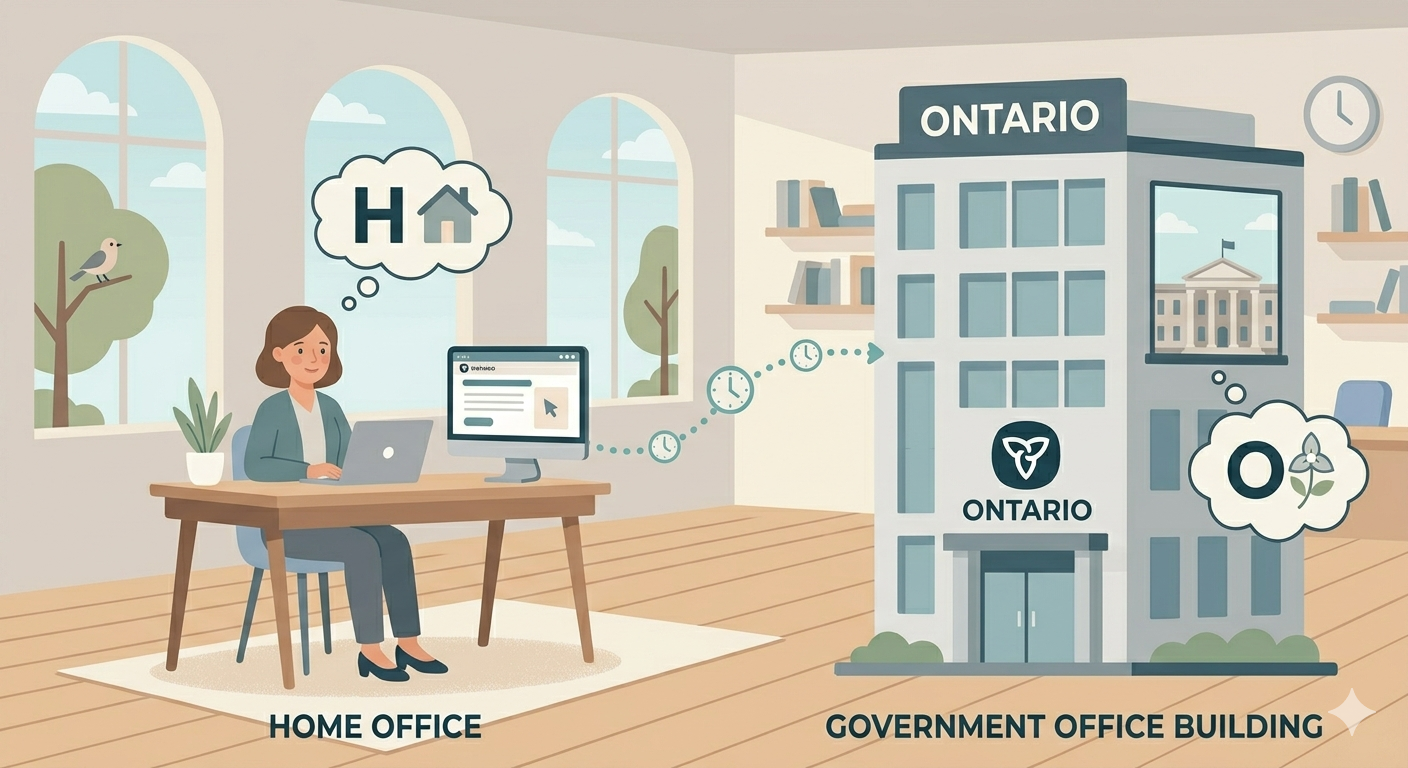
Alt text: Ontario Public Service remote work policy — flat editorial illustration showing a worker reviewing documents with home and office symbols in soft blues and greys.
How the OPS Hybrid Model Worked Before 2025
For a while, hybrid work in the Ontario government was genuinely functional. After the pandemic, the province settled into a three-day-per-week in-office standard starting in April 2022. Many employees had formal agreements in place – some dating back as far as 2010, according to AMAPCEO, the union representing professional and administrative OPS staff.
AMAPCEO represents around 14,000 professional, administrative, and supervisory employees, many of whom had opted for hybrid arrangements splitting their time between the office and home. The arrangement worked well enough that unions considered it a core part of the employment relationship.
So, for context: this wasn’t a temporary pandemic workaround for a lot of people. It had become a real and expected part of working for the province.
What Changed in 2025 – The Return-to-Office Announcement
In August 2025, the Ford government dropped the news. Treasury Board President Caroline Mulroney announced that OPS employees would be required to increase in-office attendance to four days per week starting October 20, 2025, then move to full-time in-office hours effective January 5, 2026.
More than 60,000 Ontario Public Service workers would be required to return to the office full time starting in January 2026.
The stated reasons were about productivity, mentorship, and supporting downtown economies. Premier Ford was direct about it. “How do you mentor someone over a phone? You can’t. You’ve got to look them eye to eye,” Ford said at a news conference in Pickering.
Not everyone agreed, to put it mildly.
OPSEU, the union representing roughly half of the OPS workforce, called it “a top-down decision made without transparency, without negotiation, and without any evidence that it will improve service to the people of Ontario.”
AMAPCEO president Dave Bulmer went further, arguing the government had used policy to force through changes that couldn’t be achieved at the bargaining table.
The Two-Phase Rollout
The return wasn’t immediate. It came in stages.
Phase one required employees to be in the office four days a week starting October 20, 2025. Phase two brought that to five full days, effective January 5, 2026.
That rollout created its own headaches. Thousands of workers who had hybrid arrangements for more than three years said the policy would cost taxpayers more because of the need to buy or lease new office space. The concern wasn’t unfounded. Questions were raised about whether the province had sufficient office capacity to bring all civil servants back in person, with AMAPCEO’s president claiming that some ministries and agencies were missing “entire floors worth of space.”
The government, for its part, insisted it had reviewed its 4,200 facilities across Ontario and that the vast majority had adequate space. But then came the exception that proved the rule.
The LCBO told employees in a December memo that its current floor space “does not support full-time office work for all head office employees” — and announced that its staff would remain at four days per week instead of moving to five.
In other words, even the full-time mandate had exceptions right out of the gate.
What Options Do OPS Employees Still Have?
Here’s the honest answer: not many — but some.
Alternative Work Arrangements (AWAs)
Employees who currently have what’s called an “alternative work arrangement” — a formal, signed agreement to work from a different location — are not required to follow the new in-office mandate. A government official confirmed those agreements remain valid until the expiry date in each agreement.
If you don’t have one yet, you can still request one. The provision for alternative work arrangements is included in union collective agreements, and requests are approved by a director on a case-by-case basis.
It’s worth knowing that demand has been significant. About 10,000 alternative work arrangement requests were filed by employees around the time the January 2026 mandate kicked in. That’s a substantial number – and it signals how many workers are still pushing back through official channels.
Disability and Accessibility Accommodations
This is separate from an AWA and carries more legal weight. An employee who has accessibility-related concerns may have medical reasons that require a hybrid or fully remote work arrangement. If an employee is able to show a real accommodation need, the employer must accommodate it up to the point of undue hardship.
If you’re in this situation, the advice from employment lawyers is consistent: document everything, request accommodation formally, and don’t wait.
The Recruitment and Retention Problem
Beyond the day-to-day frustrations, there’s a broader question hanging over all of this. Does ending hybrid work actually hurt the OPS’s ability to attract skilled people?
AMAPCEO president Dave Bulmer was blunt: “I represent professionals, highly educated people who can choose where to work in the market, the best and the brightest. Nobody’s going to come to an OPS that doesn’t have hybrid work.”
That concern has real data behind it. A 2025 survey by the Angus Reid Institute found that among public sector workers, fully half opposed the idea of mandatory in-office work, compared to only one in three who were in favour.
Critics argue the government’s move runs counter to its own OPS People Plan, which lists “attracting, developing, and retaining top talent that reflects Ontario’s diversity” as its chief goal.
It’s a fair tension to point out. Whether it shapes future policy is still an open question.
Where Things Stand Today
As of early 2026, the five-day-per-week mandate is officially in force for the vast majority of OPS employees. The practical reality, though, has some wrinkles.
Some organizations – like the LCBO – are still at four days due to space constraints. Thousands of AWA requests are sitting in queues with uncertain outcomes. And union negotiations continue to treat workplace flexibility as an active file.
AMAPCEO noted that some civil servants have had remote or hybrid arrangements dating as far back as 2010, and the province has confirmed it has not signed new leases or purchased real estate to accommodate the full return — a sign that practical realities are still being sorted out ministry by ministry.
So if you’re weighing a career in the Ontario government right now, the honest picture is this: formal remote work is off the table as a standard offering. AWAs exist, but they’re not guaranteed. Accommodation requests tied to medical or disability needs carry more weight. And the political conversation around this policy isn’t over.
For more context on what makes the OPS an attractive employer despite these changes, the advantages of working in the public sector are still real – pension plans, job security, and wages that hold up well against the private sector haven’t gone anywhere.
How This Fits Into the Bigger Picture
The OPS isn’t alone here. Alberta’s government followed Ontario’s lead, announcing it would end its own hybrid work policy and require all provincial employees back in the office full time, with roughly 44% of Alberta provincial employees having had hybrid arrangements as of that summer.
It’s a pattern playing out across the public sector nationally – and it connects directly to compensation dynamics that show up on the Ontario Sunshine List each year. When flexibility erodes as a benefit, the implicit value of a public sector job shifts. That’s worth watching.
You can track how OPS workforce composition and compensation are evolving through the OPS Workforce Statistics hub and the OPS Ministry Salaries breakdown on this site. For a wider read on public sector pay trends, browse more articles at PublicPayPulse’s Public Sector Insights.