

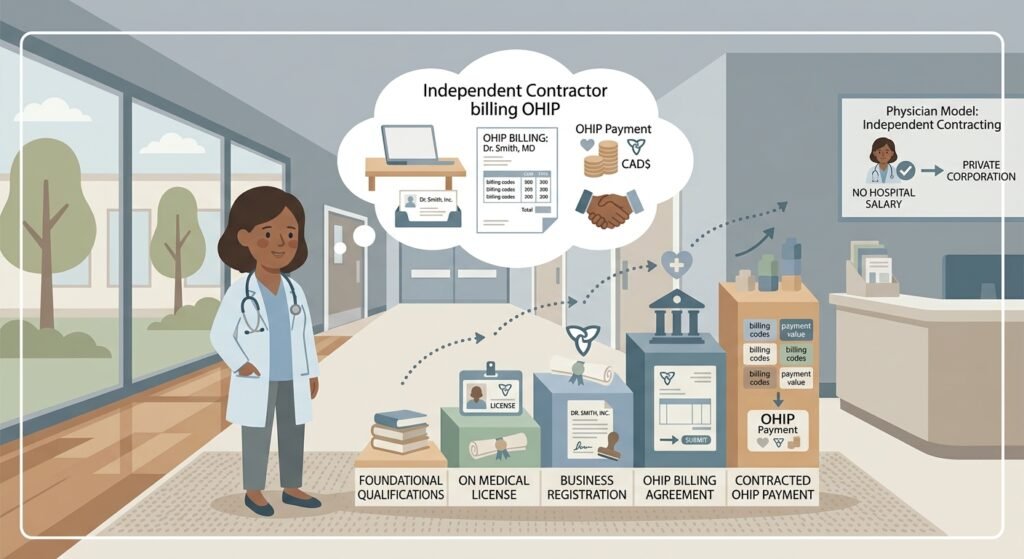
Most Ontario physicians are not paid a salary at all. They bill OHIP as independent contractors — and the Sunshine List only discloses salary paid to an employee. That single distinction explains why a doctor with very high OHIP billings may never appear on the list, while a salaried doctor in a community health centre does.
The answer in 30 seconds
Doctors can be on the Sunshine List — but only the minority who are employees of a hospital, university, community health centre, public health unit or another covered public-sector employer, and who were paid at least $100,000 in salary by that employer in the calendar year. The majority of Ontario doctors bill OHIP as independent contractors. OHIP billings are not salary, so they are not disclosed on the list at all.
“Physicians operate as independent service providers and are not government employees. Their services are billed to the Province under OHIP as established under the provincial Health Insurance Act.”
— Legislative Assembly of Ontario, Standing Committee on Public Accounts, Physician Billing (2017)
Everything confusing about doctor pay in Ontario flows from that sentence. There are two different money systems, reported in two different places, for two different purposes — and readers routinely treat them as if they were the same number.
In the OHIP system, the Ministry pays for an insured service and the money goes to the physician, group or corporation as gross practice revenue, out of which the practice pays rent, staff, equipment and insurance — plus the doctor’s own pension and benefits, because there is no employer providing them. In the employment system, a hospital, university or community health centre puts a physician on payroll, issues a T4, and — if that salary reaches $100,000 — reports it under the Public Sector Salary Disclosure Act, 1996 (the Sunshine List law). Same doctor, same province, completely different disclosure.
How Ontario doctors are actually paid
There is no single “doctor salary” in Ontario. Payment depends on specialty, setting and model — and the model determines both what the money has to cover and whether it is ever disclosed as salary.
Fee-for-service: pay per service
Under fee-for-service (FFS), a physician is paid a standard fee for each insured service, using fee codes in OHIP’s Schedule of Benefits — a schedule the Ontario Medical Association describes as listing roughly 6,000 physician services and payment rules. The Legislative Assembly’s Public Accounts report describes FFS as the principal way physicians have billed since 1972 and as still widely used today, mainly by specialists.
To bill OHIP at all, a physician needs a certificate of registration from the College of Physicians and Surgeons of Ontario and an OHIP billing number from the Ministry. Locum physicians must bill on their own billing number, not the number of a physician they are covering for.
Family medicine: enrolment and capitation models
Most organized family practice in Ontario is not pure fee-for-service. Patients enrol (roster) with a practice, and payment blends a fixed per-patient amount with fee-for-service elements:
| Model | Who | Enrolment? | How it is funded |
|---|---|---|---|
| Fee-for-service | Solo | No | Fee per service |
| Comprehensive Care Model (CCM) | Solo | Yes | Enhanced fee-for-service |
| Family Health Group (FHG) | Group of 3+ | Yes | Enhanced FFS + enrolment fees, premiums, incentives and after-hours premium |
| Family Health Network (FHN) | Group of 3+ | Yes | Blended capitation |
| Family Health Organization (FHO) | Group | Yes | Blended capitation |
What “blended capitation” actually means in an FHO: a fixed capitation payment for each enrolled patient (adjusted by age and sex), plus a fee-for-service “shadow-billing” premium for services inside the capitated basket, plus full fee-for-service for services outside the basket, plus fee-for-service for non-enrolled patients, incentives and bonuses, and an after-hours premium. The FHN works similarly, with a smaller capitated basket. In other words, even a “capitation doctor” is still partly paid fee-for-service — the categories overlap.
New from 1 April 2026 — FHO+: Under the 2024 Physician Services Agreement, the modernized FHO (“FHO+”) raised the blended fee-for-service premium for in-basket services from 19.41% to 30% and the after-hours premium from 30% to 50%, ended the access bonus / outside-use deductions and comprehensive-care capitation payments, and added an Enhanced Group Management Leadership Payment of $4 per enrolled patient per fiscal year (max $100,000 per group). New hourly codes pay $80/hour ($20 per 15 minutes) for direct, indirect and clinical-administration work, and $68/hour ($17 per 15 minutes) for telephone care when not in the office — capped at 14 hours per day and 240 hours per 28-day cycle. (Sources: Ministry of Health INFOBulletins 260308 and 260309, 1 April 2026; OMA news release, 1 April 2026 — association framing.)
Salary, sessional, hourly and Alternative Payment Plans
- Community Health Centres (CHCs) and Aboriginal Health Access Centres pay family physicians a salary — these physicians are employees, which is why they are the clearest example of doctors who do appear on the Sunshine List.
- Alternative Payment Plans (APPs) are contracts with hospitals or physician groups for defined services — emergency care, hospitalist work, remote-area coverage, training and research are typical examples. In academic centres the dominant APP form is block funding to a specialty group, which the group then allocates internally.
- Sessional, shift and hourly payments pay for time rather than services. A salaried or sessional physician may be an employee (the institution deducts tax, CPP/EI and provides benefits) or a contractor (guaranteed gross income, self-employed for tax purposes). That employee/contractor distinction — not the dollar amount — decides Sunshine List treatment.
Gross billings are practice revenue — not take-home
An OHIP billing total is gross revenue to a practice. Out of it, a community physician or group is expected to fund practice overhead and most administrative costs — rent, equipment, supplies, malpractice and other insurance, and the salaries of support staff and other health providers the group employs. An independent physician also has no employer-provided pension or benefits, and must fund disability insurance and retirement saving personally.
How large is overhead? It is genuinely disputed: the Ontario Medical Association has put it at roughly 30% of total billings on average (more in some specialties, less in others), while Ontario government analysis in arbitration put it at roughly 19–20% (about $68,780 on average gross billings of $362,600) and argued the higher figure came from inflated self-reported surveys. The safe, accurate line is: published estimates of average overhead range roughly 20–30% of gross billings, varying widely by specialty; neither figure is an official audited Ontario average. CIHI — the main source of physician payment statistics — explicitly does not adjust its published payment figures for overhead. Every CIHI average you see is a gross figure.
One related wrinkle: many physicians practise through a medicine professional corporation. The corporation does not bill OHIP — professional corporations are not issued OHIP billing numbers; the physician bills under their own number. Income retained in the corporation is taxed at the small-business rate, with personal tax applying when it is paid out as salary or dividends. That is tax timing, not exemption — and none of it turns billings into Sunshine List “salary.”
Historical context only: the last clean official split by payment model found in public sources is for 2015/16 — fee-for-service $6.33 billion, patient-enrolment models $3.38 billion, and Alternative Payment Plans $1.88 billion, of $11.59 billion paid to about 30,200 physicians (Auditor General of Ontario 2016 audit, reported by the Legislative Assembly’s Standing Committee on Public Accounts, 2017). In the same year, 8,800 of 14,100 family physicians were in a patient-enrolment model. No current official Ontario split for 2024–2026 was found — the mix has since shifted with FHO growth and FHO+ in 2026, but by how much is not published in the sources reviewed.
What the Sunshine List actually captures
The Sunshine List is not a general “public money” register. It is a specific statute — the Public Sector Salary Disclosure Act, 1996 — with specific definitions, and doctors mostly fall outside them.
- Purpose (s.1): disclosure of “the salary and benefits paid in respect of employment in the public sector to employees who are paid a salary of $100,000 or more in a year.”
- “Salary” (s.2) means amounts that must be included in income from an office or employment under s.5 of the federal Income Tax Act — in practice, T4 employment income. Since 2012 it also includes per diems and retainers paid to employees.
- “Employer” means a public-sector employer that does not carry on its activities for profit — the Crown and its agencies, municipalities, school boards, every university and college, every hospital on the Minister’s list under the Public Hospitals Act, boards of health, Hydro One, OPG, and certain other bodies meeting a provincial-funding test (generally $1 million or more in Ontario funding, or funding of at least 10% of gross revenues where that is at least $120,000).
- Timing (s.3): every covered employer must publish, by 31 March each year, the name, position, salary paid and total taxable benefits for each employee paid $100,000 or more in the previous calendar year. Ontario.ca’s disclosure hub lists datasets from 1996 through 2025 — the most recent year — as read on the hub on 17 October 2026.
- The $100,000 threshold is fixed in the statute. It is salary before taxes and does not include taxable benefits — but once a person qualifies, the total value of their taxable benefits must also be disclosed (as a total only; the Act does not authorize itemizing what the benefits are).
Disclosed vs. not disclosed
The “not disclosed” list below follows from the Act’s definitions — salary as employment income, paid by a non-profit public-sector employer to its employee — and is corroborated by CBC and Toronto Star reporting. The Act does not contain a sentence that says “OHIP billings are excluded”; they are excluded because they do not meet the definition of salary.
| On the Sunshine List | Not on the Sunshine List |
|---|---|
| Salary paid by a public-sector employer to its own employee (T4 employment income); total taxable benefits reported by that employer; per diems and retainers paid to employees (since 2012); overtime, severance, retroactive and one-time payments if they flowed through that employer’s payroll as employment income in that year. | OHIP fee-for-service billings paid to a physician as an independent contractor; capitation, APP or contract payments paid to a practice group, academic funding organization or professional corporation; private billing for uninsured or third-party services; income retained inside a professional corporation and dividends; pay from a second employer — the list never consolidates one person’s total across employers. |
As CBC reporting summarized it: the list “includes some salaried physicians, such as those who work in community health centres, but the majority of doctors who bill OHIP are not [on] the list because they are considered independent contractors.” The Toronto Star made the same point in 2017: doctors employed in the public sector, for example at hospitals, are on the list, but they are only a small fraction of Ontario’s physicians — most work as independent contractors.
Why a listed amount can be lower — or higher — than OHIP billings
Lower than billings (the common case): a physician who appears through a salaried role shows only the salary from that one employer. Their OHIP billings — from a separate community practice, or flowing to their group or corporation — are a different stream and are never added. For an academic physician, the listed university or hospital salary may be only the academic/administrative slice, with clinical earnings flowing through a practice plan, an academic funding plan, or OHIP.
Higher than billings: a physician whose main income is salary (CHC, hospital, university, public health) may bill little or no OHIP fee-for-service at all. A listed year can also be inflated by retroactive pay, overtime, severance or a retirement payout. And a physician employed by two covered employers can appear twice — once per employer — which readers either double-count or miss entirely.
Never add a Sunshine List figure to an OHIP billing figure for the same person. They may overlap, cover different roles — and different periods: the Sunshine List is a calendar year, while CIHI and OHIP figures are usually a fiscal year. Comparing them as if they were the same period is an apples-to-oranges error.
Hospital vs. family practice
Hospital-based physicians
Most hospital-based physicians are not hospital employees for their clinical work. They hold hospital privileges and bill OHIP — fee-for-service or through an APP — as independent contractors. Those billings do not appear on the Sunshine List, no matter how large they are.
Physicians who are hospital employees — certain hospitalist, emergency, laboratory, and salaried clinical or medical-leadership roles — appear under that hospital if their hospital salary reaches $100,000. Two cautions follow:
- Hospital CEOs and executives on the list are administrators, not practising clinicians. Their pay is executive compensation. Do not cite a hospital CEO’s Sunshine List salary as an example of “doctor pay” — it answers a different question.
- Academic physicians are the hardest case. In academic health science centres, funding typically flows Ministry → academic medical organization (for example SEAMO at Queen’s, TOHAMO in Ottawa) → departmental practice plan → the physician or their professional corporation. The academic funding plan is designed to cover all academic and clinical responsibilities — clinical work, teaching, administration and research — and the envelope also helps fund facilities, staffing and resources. It is not pure personal pay. Whether a given academic physician appears on a Sunshine List depends on who their payroll employer is for the portion paid as employment income, and whether that portion reaches $100,000. Practice-plan distributions paid as contract income or to a corporation are not automatically “salary.” No source reviewed verified a single general rule for how academic funding maps onto disclosure at every university and hospital — so this guide does not claim one.
Community family doctors and specialists
Community physicians typically practise independently — solo or in a group — and are paid through fee-for-service, an enrolment model (FHG / FHN / FHO / FHO+), an APP or contract, or, in a CHC / Aboriginal Health Access Centre / blended-salary arrangement, a salary. Only the last of those is employment income the Sunshine List can see.
In an FHO, FHN or FHG, capitation, premiums and bonuses are paid to the group. The group pays overhead and distributes what remains under its own internal arrangement. The Sunshine List sees none of it. Specialists follow the same logic: mostly fee-for-service plus APPs (emergency-department alternative funding, anesthesia and hospitalist arrangements, per diems). When older reporting highlights very high-billing specialties such as ophthalmology or neurosurgery, it is describing procedure volume × fee levels × overhead — a specialty with expensive equipment, facilities and staff will bill more to earn a comparable income — not a salary ranking.
Residents and fellows: employees, but usually below the line
Residents are the exception that proves the rule: they are employees, paid a salary by postgraduate year (PGY) level under the PARO–CAHO collective agreement, so they sit squarely inside the employment model the Sunshine List covers. Most simply do not earn enough to qualify.
| PARO salary, eff. 1 July 2025 | Base salary | Over $100,000? |
|---|---|---|
| PGY1 | $73,367.35 | No |
| PGY2 | $79,669.97 | No |
| PGY3 | $85,564.01 | No |
| PGY4 | $92,700.65 | No |
| PGY5 | $98,566.96 | No — just below, before call stipends |
| PGY6 | $104,167.39 | Yes |
| PGY7 | $109,250.12 | Yes |
| PGY8 | $115,826.24 | Yes |
| PGY9 | $120,082.47 | Yes |
So PGY1–PGY5 base salaries sit below the threshold, while PGY6 and above sit above it — meaning a senior resident employed by a covered hospital or university can appear, especially once call stipends (for example, $180.96 for a weekday in-hospital call and $246.98 for a weekend in-hospital call, effective 1 July 2025) and other employment income from that employer are counted. Clinical fellows are messier: University of Toronto standards require funding of at least the PGY1 rate (aligned to the PARO PGY3 scale from 2025), but the university states it is not the fellow’s employer — funding is coordinated by the hospital site or a sponsoring agency, so disclosure depends entirely on who actually pays. (Source: PARO, During Residency, salary scale effective 1 July 2025 — re-confirm on the live PARO page before publishing.)
Why the totals mislead
“The Sunshine List figure is take-home pay.” False. It is gross salary before taxes, from one employer, with total taxable benefits shown separately. It excludes income tax, CPP/EI and pension contributions — and every other income stream the person has.
“OHIP billings are a doctor’s salary.” False. Billings are gross payments for insured services — practice revenue, from which overhead is paid. Ontario’s Information and Privacy Commissioner, in a finding upheld by the courts, treated OHIP payments as gross business/professional revenue rather than personal income for exactly this reason, and CIHI reports gross clinical payments without an overhead adjustment.
“All doctors are on the Sunshine List.” False. Only physicians employed by a covered public-sector employer and paid $100,000 or more by that employer appear. The majority, who bill OHIP as independent contractors, do not.
“The highest OHIP biller is the highest-paid doctor.” Misleading. Gross billings do not subtract overhead — which varies enormously by specialty — and say nothing about hours worked, full-time vs. part-time status, or how many physicians share a group’s billings. A high biller may run a high-cost practice; a salaried physician may earn a high salary with minimal billings.
“If a doctor isn’t on the list, they’re hiding public pay.” False. Absence usually means the doctor is not a public-sector employee. Their public funding still flows — as OHIP payments to their practice, group or corporation — but the Public Sector Salary Disclosure Act was never designed to capture contract payments, and does not.
“A doctor listed at $X earned $X in total.” False. The list is per employer, per calendar year. The same physician can appear under multiple employers and can also have OHIP, corporate and private income that appears nowhere on it.
Numbers you can cite safely
Each figure below is traceable to the source named beside it. Where a figure is Canada-wide, historical, or secondary, it says so — those labels are part of the fact.
| Figure | Value | Source & period |
|---|---|---|
| Sunshine List threshold | $100,000 salary, before taxes, excluding taxable benefits | PSSDA ss.1, 3; Ontario.ca background, updated 30 Dec 2025. Fixed in statute — not indexed to inflation. |
| Most recent disclosure year | 2025 (pay in calendar 2025), published by 31 March 2026 | Ontario.ca disclosure hub, read 17 Oct 2026 — datasets listed 1996–2025. |
| Ontario physician payments | $19.5 billion to ~35,000 physicians, of which $13.3 billion fee-for-service | Auditor General of Ontario, 2025 Annual Report summary, 2 Dec 2025. Fiscal year 2024/25. All payment streams — not salary. |
| Average gross payment per physician — Canada | $383,000 overall (+3.9%); family medicine $324,000; medical specialists $406,000; surgical specialists $556,000 | CIHI National Physician Database, 2023–24, as reported by Canadian Healthcare Network (~Oct 2025). Canada, not Ontario; gross, no overhead adjustment; total payments $34.6B. |
| FHO+ hourly rates | $80/hr direct / indirect / clinical admin; $68/hr telephone | Ministry Bulletin 260309, 1 Apr 2026. Caps: 14 hrs/day; 240 hrs per 28-day cycle. |
| 2025/26 payment increases | FHO/FHN +11.7513%; FHG/CCM/FFS family +12.7535%; family salary/contracts +13.5477% | Ministry Bulletin 250406, 23 Apr 2025 — relativity-adjusted increases under the 2024 PSA arbitration award, Year 1. |
| FFS claims flagged for review | 3–5% of reviewed FFS claims had potential anomalies ≈ $400–665 million needing review | Auditor General 2025 summary, fiscal 2024/25. Context for oversight — not a finding that this amount was overpaid. |
About the top of the 2025 list: secondary reporting of the March 2026 release puts the highest-paid person overall as an Ontario Power Generation executive (Kenneth Hartwick, Special Advisor, about $1.907 million) — not a physician. Neither a total list count nor a verified “highest-paid physician” figure was confirmed against the official Ontario.ca dataset in this research, so this guide does not publish one. If you want a physician example, pull the specific row from the official 2025 dataset and check that person’s actual role and employer first.
What could not be verified
- No current official split by payment model. The most recent clean official Ontario breakdown found is 2015/16 (labelled historical above). No 2024–2026 FFS / capitation / salary-APP share was found in public sources.
- No verified highest-paid physician on the Sunshine List. The top of the overall list is dominated by energy and health-system executives, not clinicians.
- Overhead remains a dispute, not a statistic — roughly 20% (Ontario government, in arbitration) vs. roughly 30% (OMA). No audited Ontario-wide average was found.
- Academic-physician disclosure varies by institution. No source verified one general mapping from academic funding plans / practice plans onto Sunshine List disclosure.
Frequently asked questions
Are Ontario doctors on the Sunshine List?
Some are. A doctor appears only if they are an employee of a covered public-sector employer (hospital, university, community health centre, public health unit, etc.) and that employer paid them $100,000 or more in salary in the calendar year. Most Ontario doctors bill OHIP as independent contractors and do not appear, regardless of their billings.
Why is a doctor who billed $1 million to OHIP not on the list?
Because OHIP billings are not salary. They are gross payments for insured services to an independent contractor’s practice — revenue that must also cover rent, staff, equipment and insurance. The Sunshine List law discloses employment income only, so billings are outside its scope entirely.
Is OHIP billing the same as what a doctor earns?
No. Billings are gross practice revenue. Published estimates put average overhead at roughly 20–30% of billings (the figure is disputed), and an independent physician must also fund their own pension, benefits and insurance. CIHI publishes gross figures with no overhead adjustment.
Can a doctor appear on the Sunshine List more than once?
Yes. Disclosure is per employer. A physician employed by two covered employers — say, a university and a hospital — can have a separate row for each, and the list never adds them into a personal total.
Are medical residents on the Sunshine List?
Residents are employees, so they are in scope — but on the PARO scale effective 1 July 2025, PGY1–PGY5 base salaries ($73,367–$98,567) fall below the $100,000 threshold. PGY6 and above ($104,167–$120,082) clear it on base salary alone, before call stipends.
Are hospital CEOs’ salaries “doctor pay”?
No. Hospital and health-system executives on the list are paid as administrators. Their compensation is executive pay, disclosed because they are employees of a covered employer — it is not clinical physician income and should not be used as an example of it.
Sources
Official sources are listed first in the full bibliography in §7 of this review pack and linked throughout the article text in WordPress. Key sources: Public Sector Salary Disclosure Act, 1996; Ontario.ca salary disclosure background and hub; Ontario Ministry of Health INFOBulletins 260308, 260309 and 250406; Legislative Assembly of Ontario, Physician Billing (2017) and Library paper on primary care models; Auditor General of Ontario 2025 Annual Report summary; CIHI National Physician Database 2023–24; PARO resident salary scale effective 1 July 2025.