

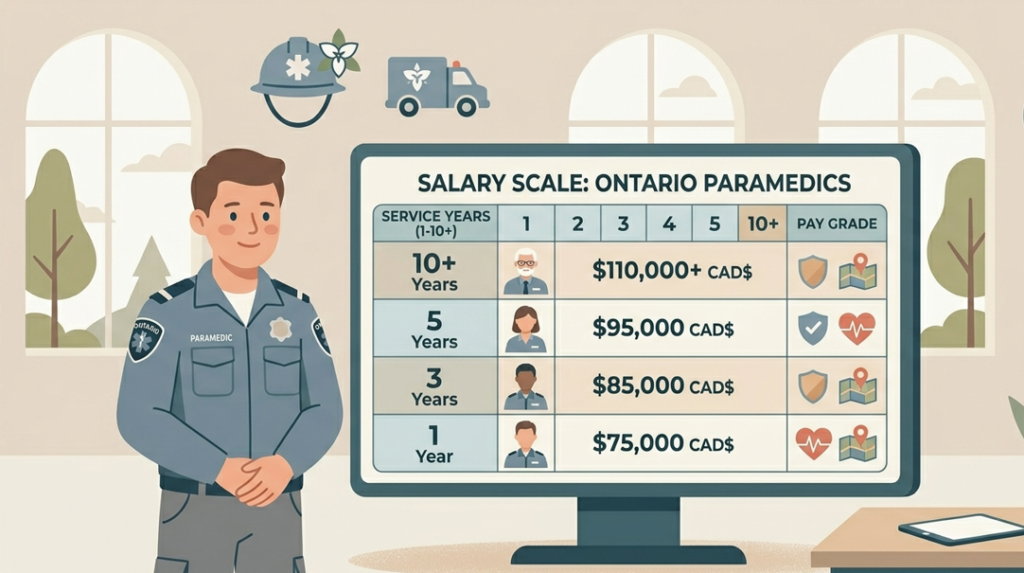
tl;dr: Ontario paramedics earn between roughly $30.75 and $50.81 per hour in base wages, which translates to anywhere from around $65,000 to well over $100,000 annually once you factor in certification level, experience steps, shift premiums, and overtime. Primary Care Paramedics (PCPs) start lower, Advanced Care Paramedics (ACPs) earn more, and Critical Care Paramedics (CCPs) sit at the top of the pay scale. Add a defined-benefit pension through OMERS and the total compensation picture looks quite different from the base hourly rate alone.
If you’ve ever wondered what Ontario paramedics actually take home – not just the headline number you see on a job posting, but the real picture – this article is for you. Ontario paramedic salary figures can look confusing at first glance because compensation is tied to certification level, years of experience, shift structure, and which service you work for. There’s no single answer, but there’s a clear framework.
Let’s walk through it.
The Baseline: What Government Data Says About EMS Pay in Ontario
The most reliable public starting point for Ontario paramedic wages is Canada’s Job Bank, which tracks labour market data by occupation. According to Job Bank’s November 2025 update, paramedics working in Ontario typically earn between $30.75 and $50.81 per hour, with a median around $42.17 per hour.
People working as a paramedic in Ontario usually earn between $30.75/hour and $50.81/hour, according to data updated on November 19, 2025.
That median hourly rate works out to somewhere around $87,700 to $92,100 per year, depending on how you count hours. Paramedics don’t usually work a standard 40-hour, 2,080-hour year. Many paramedic services run 12-hour rotations that average about 42 hours per week, which converts to roughly 2,184 hours per year – and some pay grids use that 2,184-hour figure for step progression.
So when you see a base salary figure, it’s worth asking which hours-per-year assumption is baked in.
Indeed’s salary tracker, based on 215 reported salaries updated in early 2026, puts the average Ontario paramedic wage at $41.58 per hour. That’s close to the Job Bank median and a useful cross-check.
PCP, ACP, CCP: How Certification Level Drives Your Pay
This is where Ontario paramedic salaries get more interesting. The province has three main certification levels, and they don’t all earn the same rate.
Primary Care Paramedics (PCPs) are the entry-level designation. They handle assessment, stabilization, and transport, and their pay reflects that starting point. ACP roles usually post higher rates than PCP in many regions and contracts, because the scope and training requirements are higher.
Advanced Care Paramedics (ACPs) have a broader scope of practice – think IV therapy, additional medications, more complex interventions. That additional training and responsibility shows up in the pay grid.
Critical Care Paramedics (CCPs) and specialty roles like flight paramedics sit at the top. These positions often require additional certification and are typically found in air ambulance services or dedicated critical care transport units. Ornge, Ontario’s air ambulance service, regularly posts ACP and CCP roles that sit at the higher end of the provincial range.
Senior-level paramedics with eight or more years of experience earn an average salary of around $72,123, while entry-level paramedics with one to three years of experience average closer to $43,550, according to salary survey data.
The gap between where you start and where you can land after a decade in the field is substantial.
Step Grids and Seniority: Why the Starting Rate Isn’t the Whole Story
Most Ontario paramedic services operate on a step-based pay grid, negotiated through collective agreements. You don’t just get hired at a flat rate – you move through steps as you accumulate years of service. Starting rate and top rate can be very far apart on the same grid.
Experience credit matters. Some employers recognize years of service from another paramedic service for wage placement, which can mean starting at a higher step than a new hire. If you’re moving between services, it’s worth checking whether your existing experience will be recognized.
Some regions have seen meaningful wage growth through recent rounds of bargaining. When a large service settles a major contract, nearby employers may feel competitive pressure to match those gains, pushing hourly rates and base salaries notably higher.
Shift Premiums, Overtime, and Total Annual Earnings
Base wages are only part of the picture. Ontario paramedic pay is also shaped by:
- Night and weekend premiums – many collective agreements include additional pay for hours worked outside a standard Monday-to-Friday day shift
- Holiday pay – statutory holiday work often triggers premium rates
- Overtime – Ontario’s Employment Standards Act has special rules for paramedics
Here’s something worth knowing on the overtime front. Paramedics and emergency medical attendants in the land and air ambulance industry who are represented by a union are not entitled to statutory overtime pay under the ESA. Instead, overtime and additional hours are governed by what’s negotiated in the collective agreement. That means the specific agreement your service operates under matters quite a bit.
Despite that ESA exclusion, many services run high enough call volumes that paramedics end up working significant additional hours. A busy service with steady overtime can lift annual income considerably – and Ontario’s public sector salary disclosure list shows paramedics appearing above $100,000 in years with heavy overtime.
For context, Ontario’s Sunshine List captures public sector employees who earned more than $100,000 in a given year. Paramedics do appear on it regularly, especially those in senior roles or on services with chronic staffing shortages and high call volumes.
You can browse public salary data trends across other public sector roles in the Public Sector Insights hub on PublicPayPulse.
The Staffing Crisis That’s Putting Pressure on Paramedic Pay
It’s hard to talk about Ontario EMS wages without mentioning what’s happening with staffing. There’s a real workforce crunch, and it’s affecting services across the province.
According to the Ontario Association of Paramedic Chiefs, in 2023 the province needed 1,388 paramedics but only hired 997. Chronic understaffing has left some ambulance services unable to consistently meet service demands, with unfilled shifts and off-road units reducing emergency response availability.
CUPE’s Ambulance Committee of Ontario represents roughly 8,000 paramedics and communications officers across 24 services. Their reports consistently flag escalating workloads, burnout, and retention challenges as key issues. A supermajority petition calling for fair deal and urgent action on paramedic retention was delivered by CUPE 4911 members in Peterborough in May 2026.
None of that is great news for service delivery – but it does create upward pressure on wages as services compete to attract and keep staff.
Part-Time and Casual Roles: A Different Compensation Structure
Not every paramedic in Ontario works full-time. Many services rely on part-time and casual staff, and those roles come with a different pay structure.
Part-time or casual roles sometimes pay an extra percentage instead of benefits – you’ll see language like “13% in lieu of benefits” plus vacation pay. That makes the hourly number look higher, but it’s replacing health, dental, and pension value you’d otherwise receive as a full-time employee.
If you’re evaluating a casual or part-time posting, it’s worth running the math on what that percentage replaces before assuming a higher hourly rate means better total compensation.
For a broader look at how part-time and full-time pay structures work across Ontario public sector roles, check out the OPS Careers section on PublicPayPulse.
The OMERS Pension: What It Actually Means for Paramedics
This is probably the most underappreciated part of the Ontario paramedic compensation package.
Most municipal paramedics in Ontario are enrolled in OMERS – the Ontario Municipal Employees Retirement System. OMERS is one of the largest defined benefit pension plans in Canada, with more than 1,000 participating employers and 500,000 active and retired members.
For paramedics specifically, OMERS has a supplemental plan. Paramedics classified as NRA 60 members accrue pension at a straight 2% rate per year of service, based on their best five-year average salary. They can retire with an unreduced pension at age 60, or at any age after 25 years of service.
That’s a meaningful benefit. A paramedic with 25 years of service and an average best-five-year salary of $90,000 would be looking at a guaranteed annual pension of $45,000, indexed to inflation – before CPP or OAS.
Ontario paramedics recently won a significant campaign for pension fairness, securing the right to bargain access to the same early retirement options available to firefighters and police officers – the ability to retire at 60 without pension reductions. That change, won through years of advocacy by CUPE and OPSEU/SEFPO, is still being negotiated into individual collective agreements service by service.
How Ontario Paramedic Salaries Compare Across the Province
Geography plays a role in EMS compensation, though perhaps not as dramatically as in some other professions.
The average pay range for a paramedic varies by as much as $15,000 across Ontario, which suggests there are real opportunities for advancement and increased pay based on skill level, location, and years of experience.
Larger urban services, particularly in the GTA, tend to have more settled collective agreements and established wage grids. Rural and smaller services often struggle more with recruitment and may offer competitive rates to attract candidates. Ornge, the provincial air ambulance, operates under its own agreement and offers a distinct compensation structure for flight paramedics.
Salaries for paramedics are expected to rise as the aging Canadian population and higher rates of chronic illness drive demand across the EMS sector.
What Ontario Paramedics Earn: A Quick Summary
If you want a simple reference point:
- Entry-level PCP: roughly $30–$35/hour at the start of a grid
- Mid-career ACP: roughly $42–$47/hour at mid-step
- Senior paramedic / CCP: up to and sometimes above $50/hour, plus shift premiums
- Annual income range: approximately $65,000 to $110,000+ depending on hours worked, overtime, and service
Add the OMERS defined-benefit pension, health and dental coverage, and the ability to retire as early as 60 with 25 years of service, and the total compensation package is competitive relative to the physical and psychological demands of the job.
For more context on how Ontario public sector workers are compensated across different roles, browse the Public Sector Insights hub for salary guides covering nurses, firefighters, correctional officers, and more.
Authoritative sources: