

tl;dr: More Ontario teachers are crossing the $100,000 mark than ever before — and the 2025 Sunshine List makes that crystal clear. Nearly half of the growth in last year’s disclosure was driven by the school board sector, with teachers accounting for 87% of that increase. Retroactive pay from the repeal of Bill 124, combined with collective bargaining wins, pushed thousands of educators over the threshold. This article breaks down what that means, how teacher salary grids work, and whether a six-figure teacher salary is actually as remarkable as it sounds.
Why Ontario Teacher Salaries Keep Coming Up on the Sunshine List
If you follow the Ontario Sunshine List at all, you’ve probably noticed that teachers show up a lot. Every spring, the conversation starts up again — usually with some version of “how are there so many teachers on this list?” And honestly, it’s a fair question.
The short answer is that Ontario teacher salaries have been rising steadily for years, and the $100,000 Sunshine List threshold has never moved. Not once since 1996. So as wages go up and the threshold stays frozen, more educators land on the list almost automatically.
But 2025 was different. The jump in the school board sector wasn’t just the usual gradual drift. It was a notable spike — and there’s a specific reason for it.
The 2025 Sunshine List — which covers salaries paid in the 2024 calendar year — showed 404,922 public sector employees across all sectors, a 7% increase from the previous year. That’s the first time the list has ever crossed the 400,000 mark. And according to the Ontario government, nearly half of that growth was driven by school boards, with teachers accounting for 87% of the increase in that sector.
That’s a significant number. So what’s behind it?
Bill 124: The Law That Changed Everything
To understand why teacher salaries spiked on the 2025 Sunshine List, you need to know a bit about Bill 124.
Back in 2019, the provincial government passed legislation that capped salary increases for broader public sector workers — including teachers — at just 1% per year for three years. The intent was to control public sector wage growth. But in 2023, Ontario’s Court of Appeal declared the law unconstitutional, ruling that it violated workers’ rights to freedom of association and collective bargaining.
That ruling had a big financial consequence. Teachers were owed compensation for the wages that were artificially held back during those three years. An arbitrator later awarded elementary and secondary teachers a 2.75% retroactive pay increase for the 2021-22 school year alone, on top of 0.75% for each of the two years prior.
In practice, that meant many teachers received a lump-sum retroactive payment in 2024 — which landed directly in that year’s taxable income. For educators who were already close to the $100,000 mark, that extra payment pushed them over the line and onto the Sunshine List for the first time.
It’s worth noting this wasn’t a pay raise in the traditional sense. It was compensation that teachers were already owed and had simply been waiting to receive. But the Sunshine List captures what was paid in a given calendar year, not what was earned over time — so the timing created a sharp, visible spike.
How Ontario Teacher Salary Grids Actually Work
If you’re not familiar with how teacher pay is structured in Ontario, it helps to understand the grid system before jumping to conclusions about six-figure salaries.
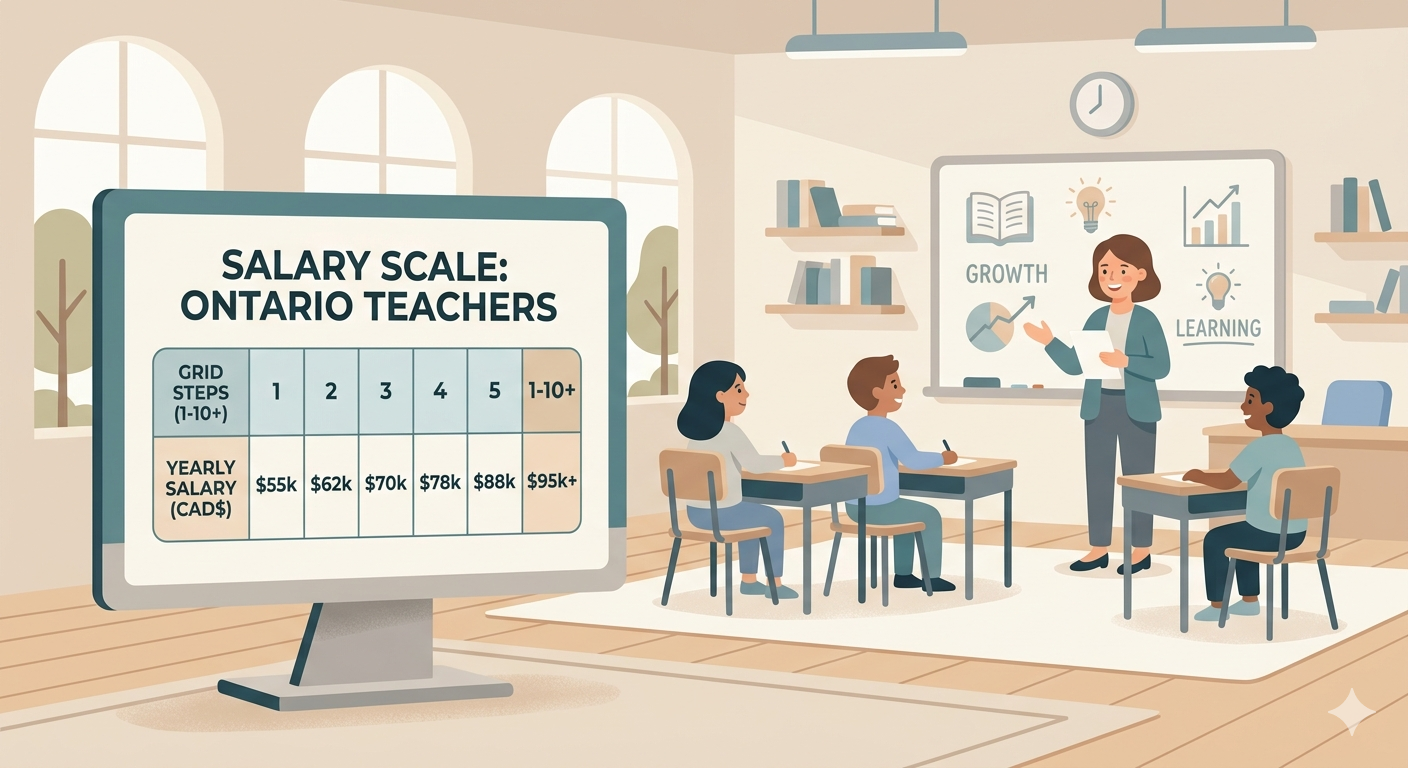
Teachers in Ontario are paid according to salary grids that are negotiated through collective bargaining. Your position on the grid depends on two things: your qualifications (education level and additional credentials) and your years of experience. As you gain seniority and add qualifications, you move along the grid and your salary increases accordingly.
For example, under the ETFO Halton local agreement for the 2024-25 school year, the salary grid ranges from around $50,000 at the entry level, all the way up to approximately $117,000 at the top of the highest qualification category. A teacher at the top of their grid — typically someone with a master’s degree or higher and many years of experience — can and does cross $100,000 legitimately, without any overtime or extra duties.
That top-of-grid salary used to be rare. But the combination of aging teaching workforces, years of experience, and consistent negotiated increases has made it more common. Add the Bill 124 retroactive payments on top of that, and the numbers make sense.
It’s also worth pointing out that Ontario has roughly 130,000 to 160,000 publicly funded school board teachers working across the province. Even if only a portion of them are near the top of the salary grid, that’s still a large group of people who could be approaching or crossing the $100,000 mark. When collective agreements provide 11.25% in increases compounded over a four-year period — which is what ETFO members received under the 2022-2026 agreement — the math adds up quickly.
What a $100K Teacher Salary Actually Means in 2025
Here’s something worth keeping in mind before the “teachers are overpaid” debate kicks off in the comment section.
The $100,000 threshold on the Sunshine List has not been adjusted for inflation since the list was created. According to the Bank of Canada’s inflation calculator, a salary of $100,000 in 1996 would be worth roughly $185,000 today. In other words, crossing $100,000 now is nowhere near the same milestone it was when the list launched.
A grade 10 science teacher with 15 years of experience and a master’s degree sitting at $103,000 isn’t quite the same thing as a hospital CEO pulling in $900,000 — but both show up on the same list. That context gets lost pretty easily in the annual headlines.
You can dig into how the $100K threshold has eroded over time in the Sunshine List history section on PublicPayPulse, or browse related analysis at the Public Sector Insights hub.
Which Roles Within Education Appear Most Often?
Not every educator earns the same amount, and the Sunshine List captures a wide range of education roles — not just classroom teachers.
Principals and vice-principals earn allowances on top of their base grid salary, which means they tend to appear on the list more reliably than classroom teachers. Board-level administrators — curriculum consultants, instructional coaches, program directors — also tend to sit higher on the pay scale. And in some cases, retired teachers who returned to supply or occasional teaching roles during high-demand periods can also show up, depending on how much they earned in a given year.
That said, with the Bill 124 retroactive payments flowing through in 2024, a meaningful number of classroom teachers — not just administrators — likely crossed the threshold for the first time and appeared on the 2025 disclosure.
The school board sector’s share of the overall Sunshine List has also grown substantially over the past decade. If you look at the top sector employee trends from 2015 to 2024, school boards have consistently ranked among the top five, and their trajectory has steepened meaningfully since 2020.
Is This Growth a Problem?
That depends on who you ask — and what you think the Sunshine List is actually for.
If you view the list as a transparency tool for identifying unusually high public sector compensation, then the surge in teachers might feel like noise. Many of these educators are experienced professionals doing specialized work, governed by collectively bargained agreements that are publicly available. Their salaries aren’t secret, and they’re not anomalies. They’re the result of a system working as designed.
On the other hand, if you’re a taxpayer watching the total cost of the public payroll — which now exceeds $50 billion for Sunshine List employees alone — it’s reasonable to ask questions about sustainability, especially when retroactive lump-sum payments compress multiple years of increases into a single disclosure year.
The honest answer is probably somewhere in the middle. Teacher salaries are growing, the list threshold hasn’t kept pace with inflation, and one-time retroactive payments created a misleading spike in 2025. All three of those things can be true at the same time.
For a broader look at what’s driving public sector salary growth across all sectors, the Ontario Sunshine List 2025 results analysis on PublicPayPulse breaks it down clearly.
What Comes Next for Ontario Teacher Pay
The collective agreements that delivered those compounded increases are in place through 2026 for most bargaining units. ETFO members are set to see salary increases of 2.5% in 2025-26, the final year of their current agreement. That means the upward pressure on teacher salaries isn’t going away anytime soon.
Whether the $100,000 Sunshine List threshold will ever be adjusted for inflation remains an open question. It has come up in policy circles for years, but the political will to change it hasn’t materialized. Raising the threshold would reduce the list size and reduce public attention on teacher and nurse compensation — which makes it a complicated move regardless of the economic argument.
For now, educators crossing $100K will continue to be part of the annual conversation. The real question is whether that conversation is asking the right things.
If you want to search individual teacher salaries or see how your school board compares to others, the Sunshine List search tool on PublicPayPulse is a good place to start. And for more public pay trend articles like this one, the Public Sector Insights hub covers everything from police chief salaries to university administrators to OPS workforce demographics.