

tl;dr: The 2025 Ontario Sunshine List – released March 27, 2026 – crossed 400,000 disclosed employees for the first time. But behind that milestone is a quieter story: what’s actually happening to OPS ministry salaries inside the 29 provincial ministries themselves? This article breaks down what the latest data tells us, and why the numbers inside government may surprise you.
There’s always a lot of noise when the Ontario Sunshine List drops.
The headlines go straight to the top – OPG’s Kenneth Hartwick at $1.9 million, police chiefs, hospital executives, mayors. And fair enough. Those are striking numbers.
But if you work in or study the Ontario Public Service, the more interesting question is a little quieter. What’s actually happening to OPS ministry salaries – the people running day-to-day government operations across Ontario’s 29 ministries? Because that story doesn’t usually make the front page.
So let’s dig into it.
What the 2025 Sunshine List Actually Shows
The 2025 Ontario Sunshine List was released on March 27, 2026. For the first time in its nearly 30-year history, it crossed 400,000 disclosed employees – up from roughly 375,000 the year before. That’s a jump of about 7% in a single year.
Treasury Board President Caroline Mulroney noted that retroactive payments and collective bargaining outcomes were key drivers of this year’s growth. And more than half of the new additions came from municipalities – local police and fire services pushing past the $100,000 threshold, not necessarily from the ministries themselves.
That’s an important distinction.
The Sunshine List covers everyone from hospital nurses and transit mechanics to university presidents and provincial deputy ministers. The OPS – meaning Ontario’s actual government ministries – is just one piece of a much larger pie. For a deeper look at that distinction, the article Sunshine List vs. OPS Statistics: What’s the Difference? on PublicPayPulse covers exactly that ground.
Why OPS Ministry Pay Is Different From the Headlines
When most people picture a public servant, they’re probably thinking of someone in a ministry – a policy analyst, a program administrator, a regulatory inspector. Not a nuclear engineer at OPG.
And those roles tend to sit further down the Sunshine List, not at the top.
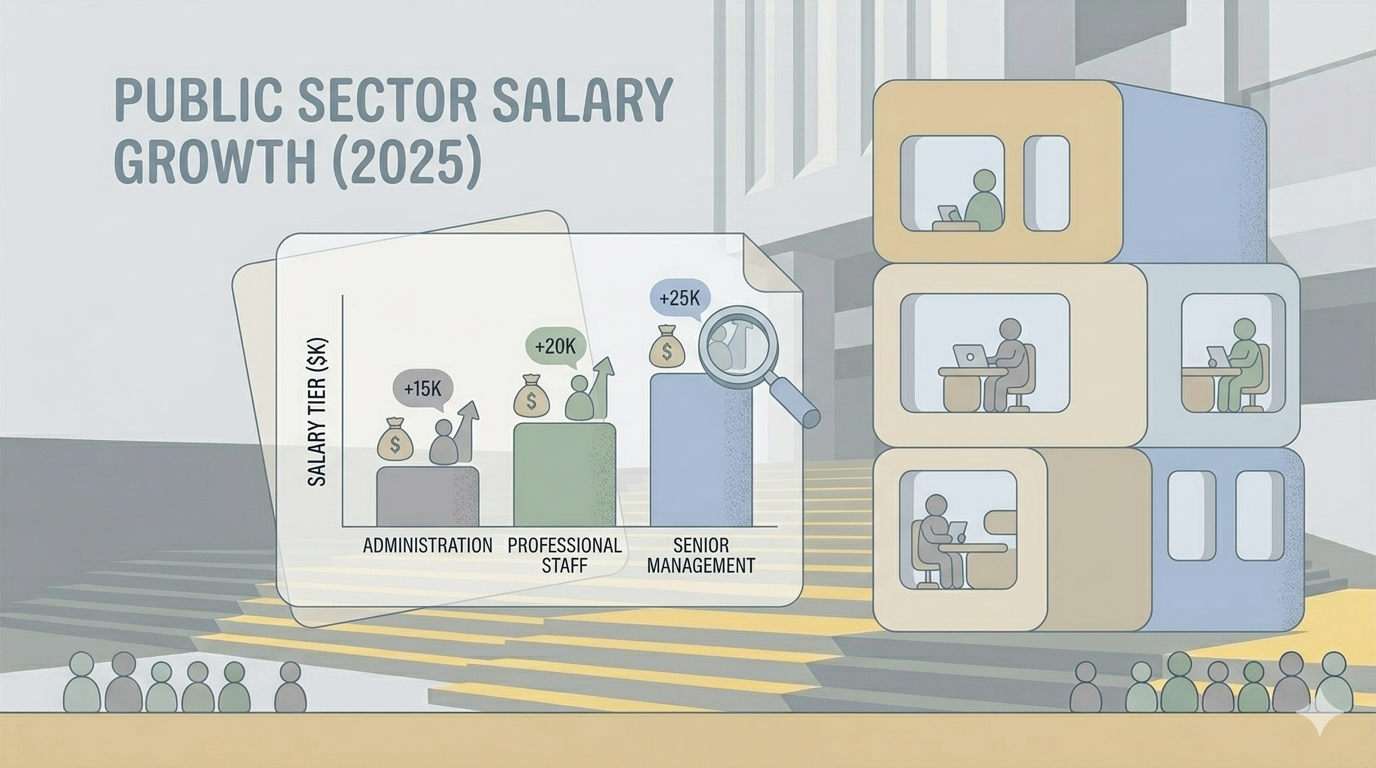
That said, senior OPS ministry roles – deputy ministers, assistant deputy ministers, directors, and senior policy leads – do appear on the list, and their compensation has been quietly climbing. Ministry leadership salaries in Ontario typically sit somewhere between $150,000 and $350,000, depending on the ministry, the scope of the role, and how long the person has been in it.
The Premier’s office itself had 50 employees on the 2025 list, up from 47 the year before. Two of those individuals earned more than Premier Doug Ford’s own salary of $269,567 – including his former chief of staff and his former principal secretary. That tells you something about how compensation works at the senior end of government.
What’s Driving Salary Growth Inside the Ministries
There are a few things pushing OPS ministry salaries higher, and they’re worth understanding on their own terms.
Collective bargaining catch-up. After several years under wage restraint legislation – most notably Bill 124, which capped increases at 1% annually – many OPS employees received retroactive settlement payments when that legislation was struck down. Those catch-up payments inflated 2024 and 2025 compensation figures. Some employees who might not otherwise have crossed $100,000 ended up on the list because of a one-time lump sum.
The frozen threshold. The $100,000 disclosure threshold hasn’t moved since 1996. Adjusted for inflation, that amount would be worth roughly $185,000 in 2025 dollars, according to CBC reporting on the list’s release. So even employees whose real purchasing power hasn’t changed much over time are crossing the threshold simply because wages have risen with inflation.
Specialization and demand. Ministries have shifted toward hiring more technical roles over the past decade – cybersecurity analysts, environmental scientists, data specialists, digital service leads. These jobs carry market rates that pull them toward or past $100,000, especially for experienced staff. You can read more about how OPS roles have evolved over time in the article How OPS Jobs Have Changed Since the 1990s.
The Sectors Where OPS Growth Is Most Visible
The biggest salary growth this year wasn’t inside the core ministries – it was in municipalities, school boards, and health care. Over 50% of the list’s growth came from municipal services, according to Treasury Board.
But that doesn’t mean ministry salaries are standing still.
Looking at broader Sunshine List sector trends from 2015 to 2024, Ontario Government Ministries have consistently been one of the top five sectors on the list. The growth is steadier and less dramatic than in, say, school boards or hospitals – but it’s real and it’s compounding year over year.
For 2025, that trend almost certainly continued. New collective agreements, merit-based pay increases within existing bands, and the ongoing move toward senior technical roles all point in the same direction.
What This Means for Transparency
Here’s something worth sitting with.
The Sunshine List was designed in 1996 to give taxpayers a way to track what government pays its highest earners. At the time, fewer than 4,000 employees appeared on it. Now we’re past 400,000. A significant number of those people aren’t senior executives or policy directors – they’re specialists, nurses, teachers, and experienced frontline workers whose wages have simply risen with time.
Whether that’s a problem or not depends on what you think the list is for.
If it’s meant to track executive compensation and senior government leadership, then a frozen $100,000 threshold is probably overdue for an update. The Ontario Government’s own OPS workforce data shows how much compensation and role complexity have shifted since the mid-1990s.
If the list is a broad transparency tool for all public-sector pay over a certain dollar amount, then arguably it’s working exactly as intended – just at a much larger scale.
Both perspectives are worth considering as the conversation around updating the threshold continues. A useful starting point on that topic is the article How the Ontario Sunshine List Works over on PublicPayPulse.
The Bottom Line on OPS Ministry Salaries in 2025
The 2025 list is the biggest one yet. But if you’re trying to understand what government actually costs – specifically, the salaries of people running Ontario’s ministries day to day – the headline numbers aren’t always the most useful place to look.
OPS ministry salaries have grown steadily, driven by collective bargaining outcomes, technical role expansion, and a threshold that hasn’t kept pace with three decades of wage growth. Senior ministry leaders now earn well above the list’s entry point, and the premier’s own office shows how compensation can differ significantly even at the top of government.
The more you dig into the data, the more you realize how varied the picture actually is.
If you want to keep exploring Ontario public pay trends, browse the full library of analysis and sector breakdowns over at PublicPayPulse Public Sector Insights.
Outbound Links:
- Ontario Public Sector Salary Disclosure – Ontario.ca
- OPS Workforce Demographics Dataset – Ontario Open Data
- Financial Accountability Office – Ontario Public Sector Employment and Compensation
Internal Links Used:
[…] composition and compensation are evolving through the OPS Workforce Statistics hub and the OPS Ministry Salaries breakdown on this site. For a wider read on public sector pay trends, browse more articles at […]